
Reflect and Summarize to Gain Big in Conversations
Tip 7: Reflect and Summarize Before Responding to Gain Big in Conversation
On the very first day of my very first in-person counseling class, I walked into a classroom of about 100 other students to start a week-long intensive for Individual Counseling. Within minutes of class starting, my professor, whom I’ve never met until this point, reminded us of our pre-intensive reading on reflective listening. She then said she was going to make a statement for us to reflect back to her. What she said nest silenced the class.
“Yesterday I turned 65. For the first time in my life, my mother, who has Alzheimer’s, didn’t call me on my birthday. Now reflect back to me what you heard me say.”
Students began reflecting back to her statements like:
- “Your joy was lost because you’re grieving the loss of your mother, though she’s still living.”
- “You were sad because you lost a part of your mom that you treasured.”
- “You felt crushed because you no longer have your mom to celebrate life’s milestones with you.”
I didn’t even know this professor, but like many of my fellow students, I was shortly in tears because I felt like I knew what it was like to be her, not because she went into great depth to explain her feelings, but because of the empathy classmates demonstrated in their reflections. That’s powerful. Even now, as I recall that day, I find myself choking up. This is the skill I want to pass on to you so your relationships can be richer and more intimate.
What is a Reflection
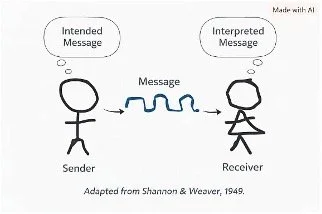
When two people communicate, a predictable process occurs that we take for granted. As seen in the wonderfully crafted AI-improved version of my hand-drawn rendition of Shannon and Weaver’s (1949) communication model below, here’s what happens:
1. A sender has something he or she wants to convey. That’s the intended message. But our ability to place our thoughts and feelings into words is limited by our vocabulary, past experiences communicating, beliefs about the listener and content of our message and much more.
2. What gets communicated is an alteration of the intended message, which is the message. Now we often think communication ends here, but the message is really just sound waves traversing through the air, coupled with all the nonverbal communication elements like our tone, posture, cadence, volume, facial expressions and so on.
3. When those sound waves arrive at the receiver’s ears, their brain translates those into meaning. That’s the interpreted message. But just like the intended message, the interpreted message is highly influenced by the receiver’s vocabulary, the context they are perceiving, and their beliefs about the sender, the environment, and how they process the nonverbal elements.
Soooooooo….when you respond to what you “heard”, you really are responding to your own brain’s interpreted message, not the message or the intended message sent by the sender! (Mind blown!)
This is why reflective listening is one of the most powerful tools in relationships. It prevents you from responding to the story your brain created and helps you respond to the actual message your partner sent.
Why Reflective Listening Works
Reflective listening prevents this communication error by postponing a response until you first confirm you truly understand what was said. Hence, like a mirror, you reflect back to the sender what you believe you heard, then, when you do respond, you’re actually responding to what the sender truly said. That’s win for both of you!
When you reflect, you’re doing three things:
1. You protect the conversation from misinterpretation.
Your brain is fast, sometimes too fast. It fills in gaps, assumes motives, and interprets tone based on your mood, past experiences, and attachment patterns (Siegel, 2012). Reflecting slows the process down so you can verify accuracy before reacting.
2. You lower emotional arousal.
When people feel heard, their nervous system calms. Gottman found that accurate empathy and attunement reduce physiological flooding and defensiveness (Gottman, 2011). Reflecting is like hitting the “let’s de-escalate” button.
3. You strengthen the bond.
Reflective listening communicates to the other person that “Your inner world matters to me.” That’s attachment gold. Johnson’s emotionally-focused therapy research shows that emotional responsiveness builds secure connection (Johnson, 2019).
What Reflective Listening Actually Sounds Like
The great news is that reflective listening is really simple. It takes a little practice, but the positive effects are so worth it!
A simple formula works beautifully:
“You felt ___ when ___ because ___.”
This captures emotion, content, and meaning, which are the trifecta of empathic reflection.
Example:
Partner: “I felt abandoned at the party last night.”
Reflection: “You felt abandoned (emotion) when I left you to talk with others (content) because socializing with strangers is hard for you to do alone (meaning).”
Notice what this does:
It shows you’re tracking their emotional experience.
It shows you understand the meaning behind the emotion.
It shows you’re not arguing, defending, or explaining.
What Happens When We Don’t Reflect
- Responding Immediately
Partner: “I felt abandoned at the party.”
You: “Well, I didn’t think it was a big deal.”
You just responded to your interpretation (“You’re overreacting”) instead of the message (“I felt abandoned”).
- Correcting their feelings
You: “You shouldn’t feel that way.” (If only it were that simple, right?)
- Problem-solving
You: “Next time just come talk to me.” (Your partner wants to be a person you understand, not a problem you solve)
- Making it about you
You: “So, you’re saying I’m a bad partner?!” (They weren’t. That’s your interpreted message.)
What This Principle Looks Like in Action
Partner: “I’m frustrated you didn’t call when you were running late.”
Reflection: “You felt frustrated (emotion) when I didn’t call (content) because I didn’t consider the effects being late would have on you (meaning).”
Partner: “Exactly.”
Now, and only now, you can respond.
Why This Matters Spiritually
Scripture repeatedly warns us about reacting before understanding:
“To answer before listening, that is folly and shame.” Proverbs 18:13 (NIV)
“Everyone should be quick to listen, slow to speak and slow to become angry.” James 1:19 (NIV)
Reflective listening is putting this biblical wisdom into practice. Slow down. Reflectively listen first. Respond second. It’s sanctified communication that loves well.
Closing
When I was in the military I lost a significant amount of my hearing. I’m due to get new hearing aids soon. I told my (eagerly waiting) family that my new ones will come with AI built into them to help me hear what I’m focusing on hearing. My daughter said, “That’s scary. What if AI tells you something you didn’t hear?” I laughed and said, “So if mom says she doesn’t like this shirt on me, the AI will whisper in my ear, ‘You’ve gotten really fat.’” I need hearing aids that do reflective listening, and your relationships probably need reflecting too.
Our partner’s words are not the problem. Our brain’s interpreted message is.
Reflective listening is how we turn it off.
References
Beck, J. S. (2011). Cognitive behavior therapy: Basics and beyond (2nd ed.). Guilford Press.
Gottman, J. M. (2011). The science of trust. W. W. Norton. Johnson, S. M. (2019). Attachment theory in practice. Guilford Press.
Rogers, C. R. (1957). The necessary and sufficient conditions of therapeutic personality change. Journal of Consulting Psychology, 21(2), 95–103.
Shannon, C. E., & Weaver, W. (1949). The mathematical theory of communication. University of Illinois Press.
Siegel, D. J. (2012). The developing mind (2nd ed.). Guilford Press.